Gurukul System of Education: Philosophy and Relevance
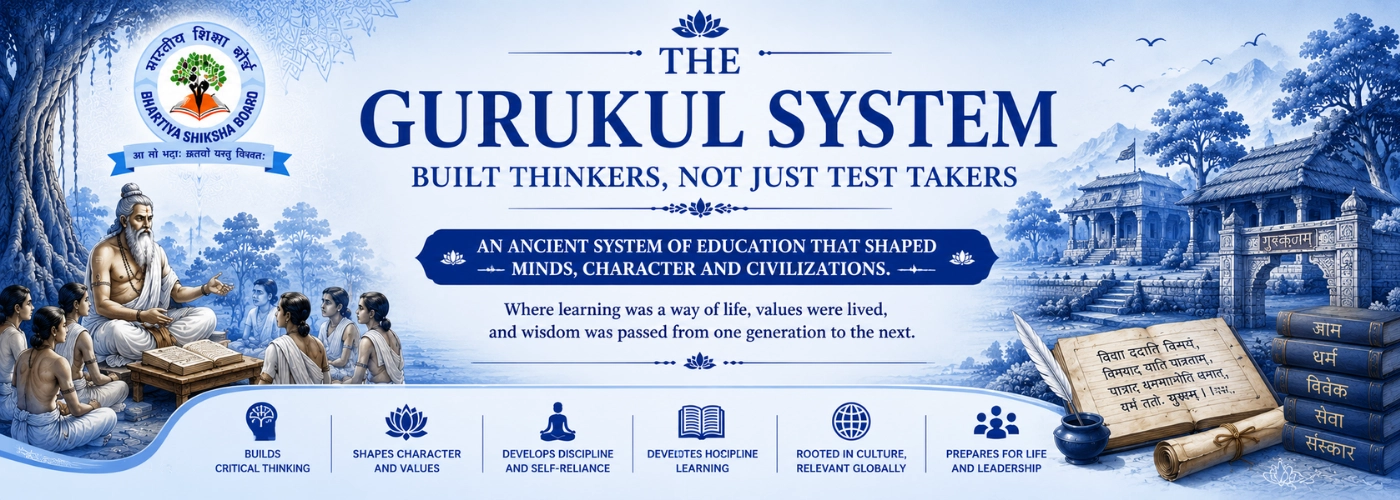
Do you prefer an education that simply helps you recall facts for exams? Or, education that helps you think for yourself, solve problems and make better decisions throughout life?
The modern education system focuses on grades. Students are rewarded if they are able to memorize facts, recite answers and score high on tests. Tests and exams are important tools to evaluate a student’s academic performance. However, they don’t necessarily measure a student’s capability to reason independently, apply their learning to real-life situations or have the temperament of a good human being.
Hundreds of years ago, Gurukul taught students differently. Education wasn’t limited to textbooks and tests. Learners lived with their guru, learnt from their day-to-day activities, participated in discussions, questioned concepts and slowly absorbed the information. The emphasis was not on what they learned, but on how they continued to learn, think and improve themselves ethically and intellectually throughout their lives.
Gurukuls did not produce students who gave the “right” answers. They aimed at developing individuals who could reason, judge situations responsibly and learn for their entire lives.
How did Gurukuls work? What was their philosophy on education? And why are we still talking about them? Read on!
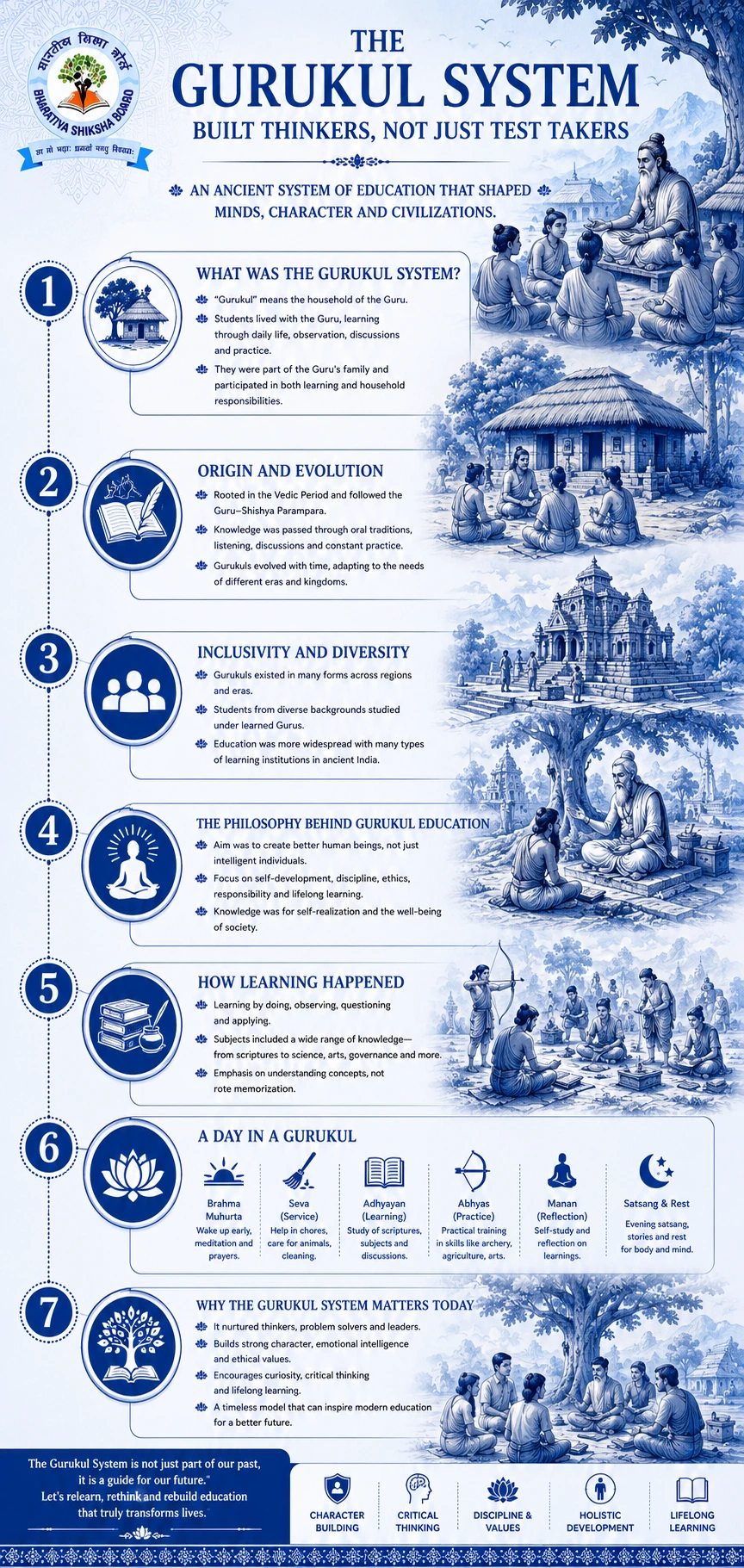
What Was the Gurukul System?
Though "Gurukul" today often translates to "school," its ancient form encompassed much more. It was one of the oldest systems of education followed in India. People did not send their children to school to read books for four to five hours every day. Education was intertwined with their day-to-day lives. Here’s how.
Origin of the word Gurukul:
The term Gurukul is made up of two Sanskrit words: Guru and Kula. Guru means teacher or mentor and Kula means family or household. Put together, "Gurukul" means "household of the teacher."
Students did not go to school and return home after the classes. They stayed with their Guru. They took lessons from their guru and everyone around them. Their entire day revolved around learning. They were more like members of the family who learned and helped with household chores.
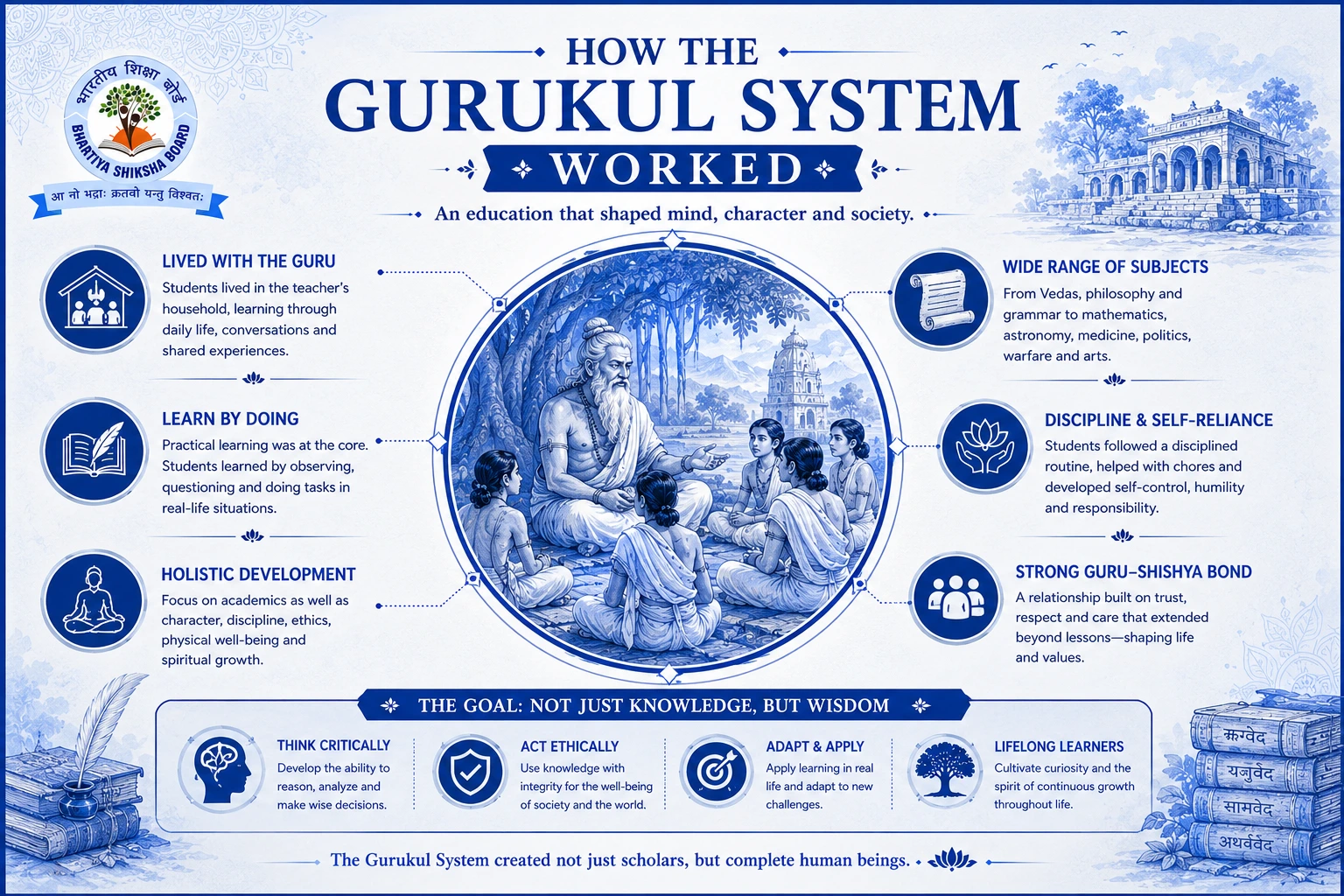
Learning in Gurukuls was not restricted to reading scriptures or listening to the guru. They learned by observing and questioning. They were an active part of the learning that took place around them. They learned by doing and implementing it in their daily chores. Academics were not the only focus; equal emphasis was placed on discipline, ethics, responsibility, and good conduct. The goal was to educate the student as well as help them in character-building.
Origin of Gurukul System:
Education in Gurukuls started as early as the Vedic period when one generation passed on their knowledge to the next. Gurukul education followed the Guru–Shishya Parampara. Before people started using writing as a method of recording information, much of this knowledge was imparted and retained through oral teaching, listening, discussions and constant practice. Gurukuls started becoming centres where students would learn about a variety of subjects like language, philosophy, math, astronomy, medicine, warfare, politics and administration. India was changing with each new era that dawned and so did Gurukuls. As new kingdoms were formed education saw new subjects being added, new methods to educate students and new centres being built for the same purpose. Education was to help one grow, acquire knowledge and wisdom to become a useful member of society.
Inclusivity and Diversity in Historical Context
Whenever someone starts talking about the Gurukul system nowadays, one of the first questions asked about it is: who could go to Gurukul and study? Well, the answer isn’t exactly a yes or a no. As with many systems that have been in practice for thousands of years, there were differences in how Gurukul was carried out across countries, kingdoms, and eras. With that in mind, accessibility also differed from place to place.
In many cases throughout history, students were accepted to Gurukuls based on their family’s traditions/occupation/customs or that particular institution’s goals. However, there are countless instances throughout Indian writings and history of students of all backgrounds studying under knowledgeable Gurus. What we can infer from this is that the Gurukul was not one specific institution.
The Gurukul was an educational practice that appeared in many forms for thousands of years. Keep in mind there were also many other places of education in ancient India. There were monastery schools, universities, temple schools, and locally-run institutions, which all taught various subjects to various people. Education was far more widespread than we are often led to believe.
When looking into India’s Gurukul system, try to look at it through a historical lens rather than present-day prejudices. It was, like most age-old traditions around the world, a mixture of ideal practices and social norms. By acknowledging both, we can have a more neutral view of its role in history.
The Philosophy Behind Gurukul Education
Imagine a place where education wasn’t restricted to books, assignments, exams, and grades but was the doorway to becoming a better human being. Where did we learn how to be humane? Yes, you guessed it right! The Gurukuls.
Following are some philosophies Gurukuls followed:
Students learn to become better human beings
The aim of education at Gurukuls was never to produce a smarter human but a better human. Learning was used as a medium to develop one’s mind and character to contribute responsibly to society. Knowledge without application and sound judgment is of little value.
Students learn about themselves
Knowledge was acquired for self-development. Gurukuls would allow students to understand their strengths and work on their weaknesses. Qualities like discipline, patience, honesty, empathy etc. were given equal importance as good grades. Students were taught to be thoughtful and responsible individuals.
Students use knowledge responsibly
Gurukuls emphasized that knowledge and responsibility go hand in hand. Students were taught with the responsibility that knowledge brings along. The aim was never to become superior to others but use your knowledge for the betterment of the society you live in and lead an honest and decent life.
Students learn for life, not for exams!
Learning at Gurukuls was never about remembering things for the exams and forgetting them soon after. Students were taught concepts in-depth and were encouraged to ask questions. They used to implement what they learned into their day-to-day life. Application of knowledge with good judgment was the real success criteria for students.
Students learn the balance between head, heart, and hand
Balance between intellect (brain), ethics (heart) and application (action) was central to Gurukul philosophy. Students didn’t limit their knowledge to just talking. They knew how to apply their learning into responsible action, thoughtful decision-making and meaningful work. This helped students prepare for the responsibility they were going to have over their family, society and the country as future leaders.
Illustration: Vidya vs Information
One of the finest examples of the above philosophy is the difference between Vidya and information. In our Indian Philosophy we have a concept of Vidya. Vidya is the knowledge which transforms a person’s intelligence, character and lifestyle. Information on the other hand can be just mere data or facts.
Today too this philosophy exists
We live in an age of information. We can Google something and know about it within seconds. But wisdom and real knowledge take time. Time for you to be curious, reflect, gain experience and apply your learning thoughtfully. Gurukuls knew that and taught their students how to use wisdom in life to make the right decisions.
Common Myths About the Gurukul System
Like many myths from ancient history, there are also misconceptions about the Gurukul system. Some of these stem from looking at this education system through a modern perspective, while others are due to generalising from situations that were actually only present at certain times and places. Reviewing these myths is a good way to arrive at a nuanced understanding of what schooling was actually like in Gurukuls.
Myth: Gurukuls only taught religion.
As the name Gurukul suggests, religious scriptures and philosophy were studied in many Gurukuls. However, the topic of religion itself was incredibly diverse, covering everything from ethics to spiritual songs. Gurukuls often specialized in certain areas of knowledge, based on their establishment and the Guru’s personal interests. Some students attended institutions to receive a well-rounded education, while others were interested in specific topics.
It’s true that different subjects held different amounts of importance based on the geographic location and time period. But there’s historical evidence of students learning mathematics, astronomy, medicine, grammar, economics, music, arts, and agriculture in Gurukuls.
Jyothisham was one specialised branch of study that received significant attention in ancient India. Courses were often tailored to what society needed, as well as what the student wanted to learn.
Myth: Students all studied the same curriculum.
Ancient India did not have one universal curriculum that all students had to follow, like many modern schools today. Different Gurukuls would often specialize in different subjects and branches of knowledge. Students were often taught based on their own interests, skills, or expected responsibilities in life.
Compare two students: one who wished to pursue medicine, and another who studied governance, philosophy and language. It’s likely that both students received very different experiences in their Gurukul. Education in ancient times was tailored to both the learner and the teacher.
Myth: Science wasn’t discussed or debated in Gurukuls.
This claim is simply not true. Many subjects that students studied in ancient India required careful observation, reasoning, calculation, and debate. Logical thinking and systematic studying were incredibly important in fields like astronomy, mathematics, medicine, grammar, metallurgy, and architecture.
Education back then was very different from modern education, but just because people didn’t learn science the way we do now doesn’t mean science wasn’t studied or discussed. Many fields of education allowed for observation, discussion, and logical reasoning.
Myth: The Gurukul education system isn’t relevant anymore.
The world is never going to go back to how it was 1,000 years ago. Education can’t and shouldn’t try to copy an ancient system that was built for a very different society and purpose. However, that doesn’t mean its foundational principles aren’t still relevant.
Many ideas from the Gurukul system are popular topics of discussion today. Educators and parents today still want their children to be taught in a personalised way, learn from experience, think for themselves, develop ethical values, and enjoy learning for the rest of their lives. By understanding how ancient educators approached these concepts, we can improve our modern education systems without having to completely emulate their methods.
Conclusion
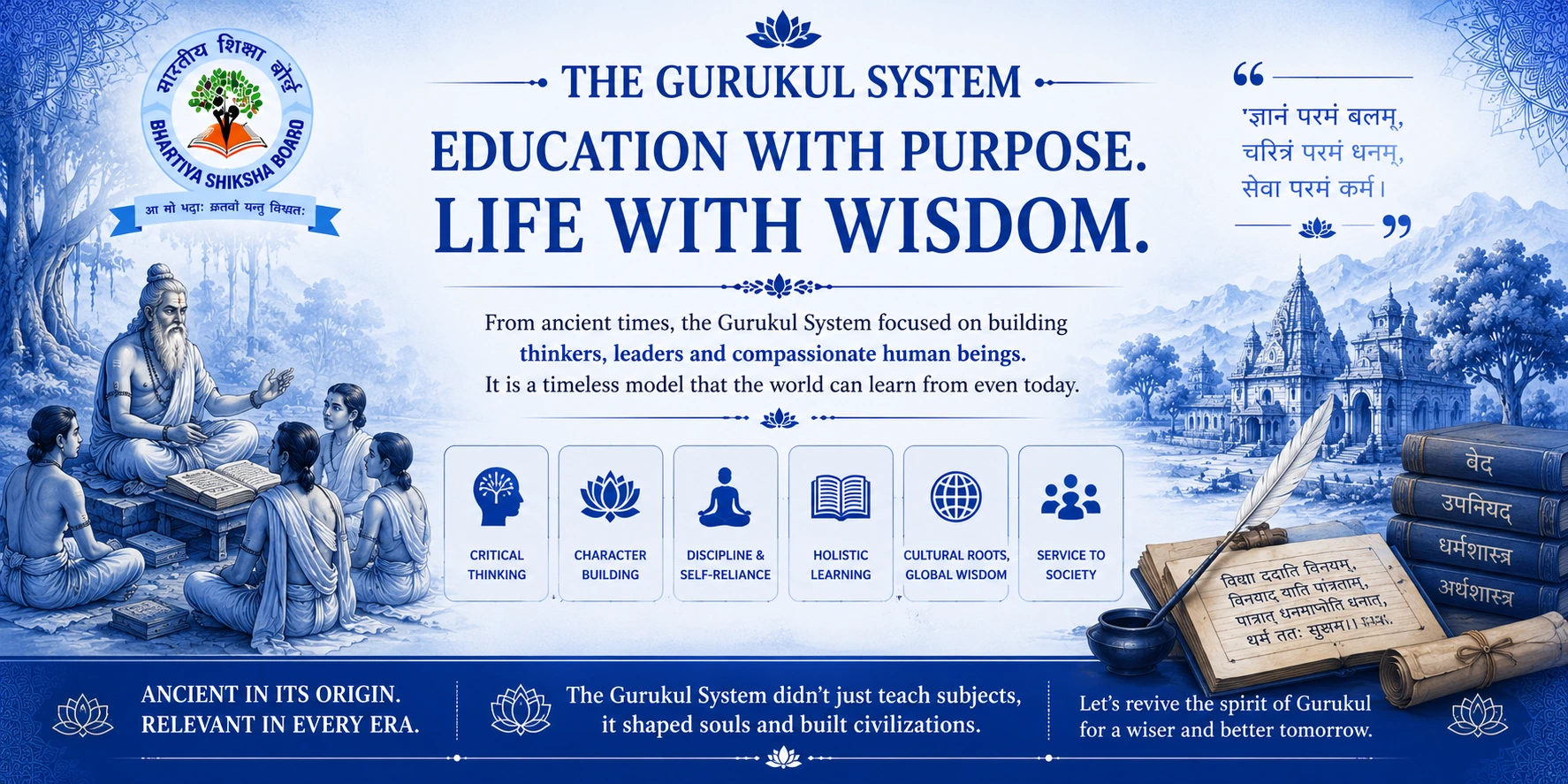
The Gurukul system teaches us that education never belonged inside classrooms, between the pages of textbooks, or on tests and exams. Education is what allows students to think for themselves, work responsibly, and learn for a lifetime. Knowledge was gained not by what a person could get a job doing with that information, but by who they could become with that information.
The world now looks very different than it did when the Gurukul system was around. We have classrooms, technological advances, scientific studies, and more information at our fingertips than ever before. Education has been changed for the better in many ways because of these developments. However, many of the questions that ancient teachers once asked are still being asked today. How do we promote curiosity? How can we help students to think for themselves? How do we teach students to use knowledge responsibly and ethically?
The Gurukul system is not leaving us with a template for modern education to copy. What it is leaving us with are teaching practices and educational principles that can still lead to productive conversations about how we educate students today. Mentorship, learning by doing, developing a strong moral compass, thinking for yourself, and learning for life are concepts that could benefit us today just as much as they could back then.
If there is one thing we can learn from the Gurukul system, it is that education’s purpose is not to produce excellent test-takers. Education’s purpose is to produce thoughtful, ethical, and skilled people who can apply what they know to better themselves and society. When we educate students in a way that allows them to understand their world, question ideas, and solve problems we are reaching education’s highest potential.
As we move forward with new innovations and reforms in education, let us not forget that facts and information alone will never be enough. Wisdom, character, and critical thinking have and always will be the pillars of true education.
Frequently Asked Questions (FAQs)
1. What was the Gurukul system?
Though "Gurukul" today often translates to "school," its ancient form encompassed much more. It was one of the oldest systems of education followed in India. Education was intertwined with day-to-day life.
2. What does the word Gurukul mean?
The term Gurukul is made up of two Sanskrit words: Guru and Kula. Guru means teacher or mentor and Kula means family or household. Put together, "Gurukul" means "household of the teacher."
3. How did students learn in Gurukuls?
Learning in Gurukuls was not restricted to reading scriptures or listening to the guru. Students learned by observing and questioning. They learned by doing and implementing it in their daily chores.
4. What was the main goal of Gurukul education?
The goal was to educate the student as well as help them in character-building. The aim of education at Gurukuls was never to produce a smarter human but a better human.
5. What subjects were taught in Gurukuls?
Gurukuls became centres where students would learn about a variety of subjects like language, philosophy, math, astronomy, medicine, warfare, politics and administration.
6. Did all students study the same curriculum in Gurukuls?
Ancient India did not have one universal curriculum that all students had to follow. Different Gurukuls would often specialize in different subjects and branches of knowledge. Students were often taught based on their own interests, skills, or expected responsibilities in life.