Classroom Management in Indian Schools: From Control to Anushasan
Walk into a school and visit two separate classes. In the first classroom, thirty students are silent while working on a problem, with a few students peeking over at others to compare answers. The teacher is walking around the room, assisting the students. In the other classroom, thirty students are also silent, but they have been ordered to be silent by the teacher.
Though both classrooms are silent from the corridor, the situation is entirely different in each classroom.
Noise is often the first thing discussed when classroom management comes up. Teachers who can maintain silence in the classroom are considered to be good disciplinarians. Teachers who find themselves unable to control the noise in the classroom have, supposedly, lost control of the classroom. However, this understanding of classroom management misses the point. Classroom management involves the teacher creating an environment in which students can learn. The noise, or lack of noise, in the classroom tells teachers very little about their management skills.
Good classroom management means students lose less instructional time and have more opportunities to ask questions. For students, classroom management is where they first learn to work with others, focus on tasks, and take responsibility for their actions.
What Is Classroom Management?
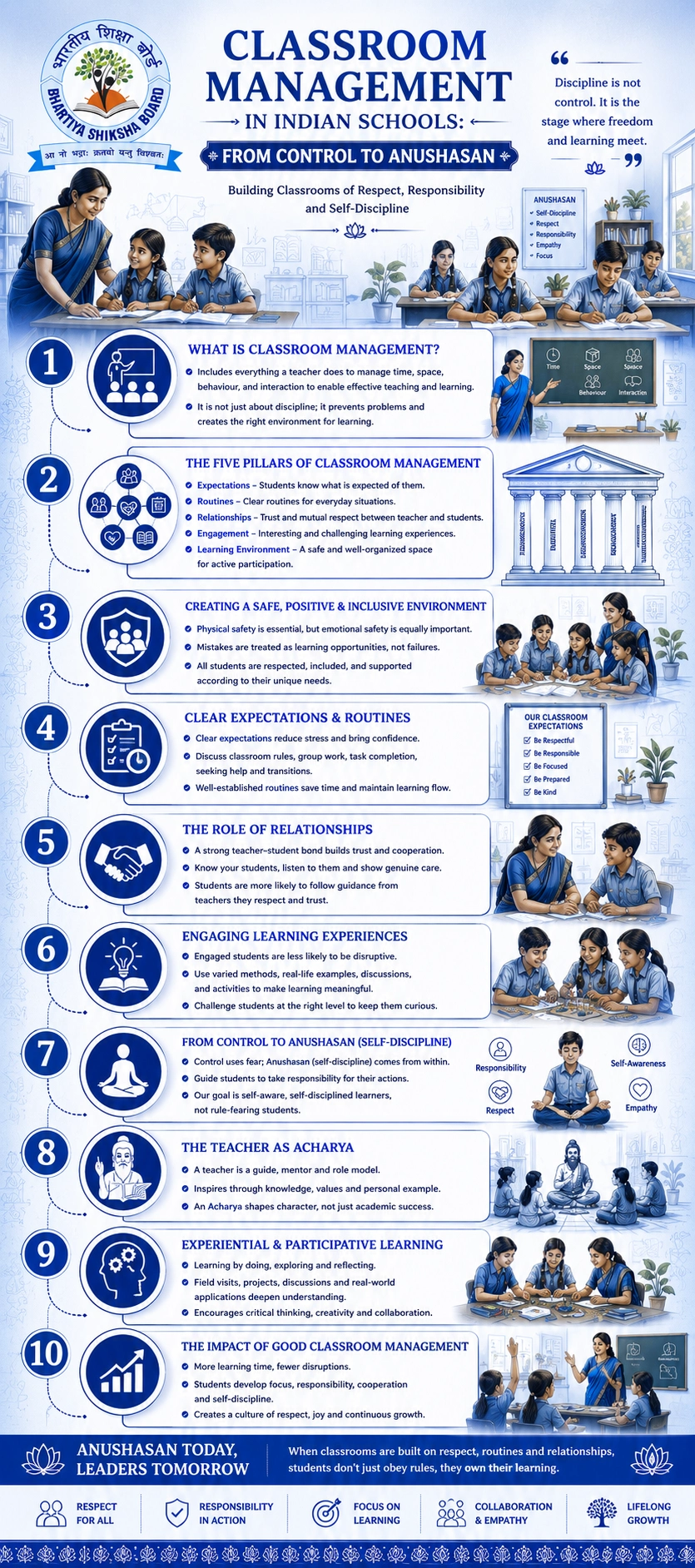
Classroom management includes everything a teacher does to manage time, space, behaviour, and interaction in the classroom to enable teaching and learning to occur. Such aspects may include how the classroom day starts, how the teacher distributes classroom materials, how students move from task to task, how questions get asked, and how problems are dealt with when they arise during the day.
Classroom management is not the same as discipline. Discipline is only one part of classroom management and typically occurs after a student has broken a rule. Classroom management includes preparing the classroom and its environment in a way that minimizes the likelihood of problems emerging in the first place.
A useful way of thinking about classroom management is in terms of five things working together:
- Expectations. Students are made aware of what is expected of them before a situation arises.
- Routines. There are established routines for situations that occur regularly.
- Relationships. Teachers know their students, and students trust their teachers.
- Engagement. The tasks assigned are interesting and appropriately challenging.
- Learning environment. The environment in which students learn allows them to participate actively in the learning process.
Any weakness in these areas can manifest as a behavioural problem in the classroom. Thus, behavioural problems are often misdiagnosed. A student who disrupts the class every Thursday afternoon may not actually have a behavioural issue; they may simply have lost focus in the first few minutes of the class.
Creating a Safe, Positive and Inclusive Learning Environment
When a child does not feel safe, learning becomes much more difficult. This sentiment has meaning beyond the emotional; a child’s ability to focus and retain information is compromised in an environment where they are afraid of making mistakes.
The physical safety of the classroom is relatively easy to provide and maintain. Ensuring that desks are arranged appropriately to allow the teacher to see all students in the room, that the room is well-lit and well-ventilated, and that all laboratory equipment and activities are appropriately supervised by teachers are requirements that most classrooms already have in place.
However, emotional safety requires additional consideration. For instance, a teacher must ensure that a “wrong” answer to a maths problem is treated as an opportunity to gain new information about the subject rather than as evidence of a student’s general inability in that subject. Additionally, all students, regardless of their background, must be treated with respect and consideration by the teacher. The teacher must also be willing to ask students questions rather than assuming that they already know the answers or sighing when they make mistakes.
Inclusion is embedded in this idea. Students who speak different languages may come from different backgrounds and may have different levels of support from their parents. If, as a teacher, you are thinking only about the average student in your classroom, you are ignoring the students who may need additional support.
Schools aligned with Bhartiya Shiksha Board put emphasis on holistic development, inclusive learning environments, and creating classrooms where students can participate and ask questions. Creating a safe classroom environment is therefore an important responsibility for teachers to follow.
One of the main ways to create this environment is by setting clear expectations in the classroom. Students will feel stressed if they are unsure of what is happening or what is expected of them. If the teacher has discussed how to work in groups, what will happen when someone finishes a task, and what students should do when they need help, students will feel more confident participating in the classroom. They will also be more willing to attempt an answer to a question, even when they are not sure that they know the correct answer.
From Control to Self-Discipline
Anushasan (अनुशासन) is commonly translated as ‘discipline’. In an educational context, however, it can be understood more broadly as disciplined conduct that is guided by principles and gradually internalised by the learner. It refers to behaviour that comes from within the student. The English word, by contrast, is often understood as external control or enforcement.
Behaviour corrected through fear will break down when the teacher is no longer in the classroom.
Self-control can be learned over time, and developing it should be the goal for every student. A self-controlled student will know how to begin their work without being asked to do so, return to a task after becoming distracted, and manage frustration without becoming unkind to others. Such behaviour can be learned by exposing students to these concepts, giving them tasks that are slightly beyond their current capabilities but achievable with appropriate support, and allowing them to observe others who demonstrate such behaviour.
The best way to correct students is with dignity. Focus on the behaviour rather than labelling the student as a whole. Correct the student in private whenever possible. Explain the reason for the correction rather than simply correcting them because the teacher has the authority to do so. Give students a way to recover from the consequences of their actions and return to the classroom without being labelled as a “bad” student. While public humiliation may appear effective in the short term, it is not worth the cost in the long term.
The Teacher as Acharya, Mentor and Classroom Leader
“आचार्य देवो भव,” from the Taittiriya Upanishad, places responsibility on the teacher as well as the student. An acharya is someone who teaches not only through the spoken word but also through example. What you expect of your students should be visible in your own behaviour.
Children are excellent at reading their teachers. They learn from you who you are, even when you do not intend to teach them those lessons.
Four qualities do most of the work here. First, fairness: the same standard should be applied to the best-performing student in the classroom and to the student who struggles the most, to the child of the most influential parent and to the child whose parents have little influence or status.
Second, consistency. Expectations and rules need to be applied consistently. A rule that is enforced on Monday but ignored on Friday is not really a rule as far as students are concerned.
Third, empathy. If a student suddenly becomes withdrawn or aggressive towards others in the classroom, there is usually some explanation. Perhaps they are hungry, perhaps someone in their family is ill, perhaps they are being bullied, or perhaps they have a vision problem.
Fourth, integrity. There is nothing that a teacher loses by admitting an error in front of a classroom of students. In fact, admitting an error demonstrates a kind of honesty that students do not often see from adults.
Yet none of this can happen if a teacher does not know their students. This means knowing who will ask for tasks to be repeated, who will never speak unless spoken to, who finishes their work early and needs something more challenging to do, and who tends to daydream about life at home. Knowing these details about your students is part of making any classroom-management strategy work.

Keeping Students Engaged Through Experiential Learning
Much of the challenging behaviour in the classroom starts with disengagement. For the student who finished the task ten minutes ago, and for the student who stopped listening twenty minutes ago, there is likely a need for something else to engage them. Engagement is a management technique before it becomes a teaching technique.
Experiential learning allows students to do something rather than simply sit through something. This can involve discussions in which students answer questions posed by their peers, questions that have multiple defensible answers, and group work that gives each student a specific role within the group.
Some methods that have been successful with students include projects that take place over multiple class sessions, using materials that are readily available in the classroom, playing games with educational goals, and incorporating stories into lessons. Art can also be incorporated into other classroom subjects, while walks and other field trips can provide opportunities to connect learning with the curriculum.
Some of these ideas also resonate with descriptions of learning in traditional Gurukul settings, particularly the emphasis on observation, participation and learning through experience. While incorporating an activity into the classroom may not end behavioural problems, it can reduce the boredom that often contributes to them.
Conclusion
Classroom management is the least glamorous but one of the most important tasks of teaching. It may appear only once in school reports, under the heading of “behaviour,” but it determines how much of the curriculum is actually delivered to students.
Safety, self-discipline, the conduct of the teacher and real engagement are what a well-managed classroom is built from. And they explain why it can be noisy sometimes, but is always busy with purpose.
Frequently Asked Questions (FAQs)
1. What is classroom management?
Classroom management includes everything a teacher does to manage time, space, behaviour, and interaction in the classroom to enable teaching and learning to occur.
2. Is classroom management the same as discipline?
Classroom management is not the same as discipline. Discipline is only one part of classroom management and typically occurs after a student has broken a rule.
3. What are the five key elements of classroom management?
The five things working together are expectations, routines, relationships, engagement, and learning environment.
4. Why is a safe classroom environment important for learning?
When a child does not feel safe, learning becomes much more difficult. Fear of making mistakes can affect a child's ability to focus and retain information.
5. How can teachers create a safe and positive classroom environment?
A teacher must ensure that a “wrong” answer is treated as an opportunity to gain new information rather than as evidence of a student’s general inability. All students, regardless of their background, must also be treated with respect and consideration.
6. How do clear expectations help classroom management?
Students will feel stressed if they are unsure of what is happening or what is expected of them. Clear expectations about group work, finishing tasks, and asking for help can make students feel more confident participating in the classroom.
7. What is the difference between discipline and self-discipline?
Anushasan (अनुशासन) is commonly translated as ‘discipline’. In an educational context, however, it can be understood more broadly as disciplined conduct that is guided by principles and gradually internalised by the learner. It refers to behaviour that comes from within the student. Discipline is applied from outside after a rule is broken; self-discipline comes from within and holds when nobody is watching.
8. What is the goal of developing self-control in students?
Developing self-control should be the goal for every student. A self-controlled student will know how to begin their work without being asked, return to a task after becoming distracted, and manage frustration without becoming unkind to others.